SARS-CoV-2 genome reconstruction and lineage assignment from ONT tiled-amplicon data
Questions
- How can a complete analysis, including viral consensus sequence reconstruction and lineage assignment, be performed on a batch of samples?
- How are tiled-amplicon (ARTIC) ONT data handled differently from other sequencing data?
- What are key results beyond consensus genomes and lineage assignments that need to be understood to avoid inappropriate conclusions about samples?
Objectives
- Obtain the recommended Galaxy workflows for SARS-CoV-2 ONT tiled-amplicon data
- Run a workflow to discover mutations in a batch of viral samples amplified with the ARTIC v5.3.2 primers
- Run a workflow to summarise and visualise the mutations of a batch of samples
- Run a workflow to construct viral consensus sequences
- Assign the samples to lineages with Pangolin and Nextclade
- Combine information from different analysis steps to draw appropriate conclusions about individual samples and batches
This tutorial is adapted from the Galaxy Training Network tutorial Mutation calling, viral genome reconstruction and lineage/clade assignment from SARS-CoV-2 sequencing data (Wolfgang Maier, Bérénice Batut), restricted to the analysis of tiled-amplicon ONT data.
ARTIC Protocol
https://artic.readthedocs.io/en/latest/primer-schemes/
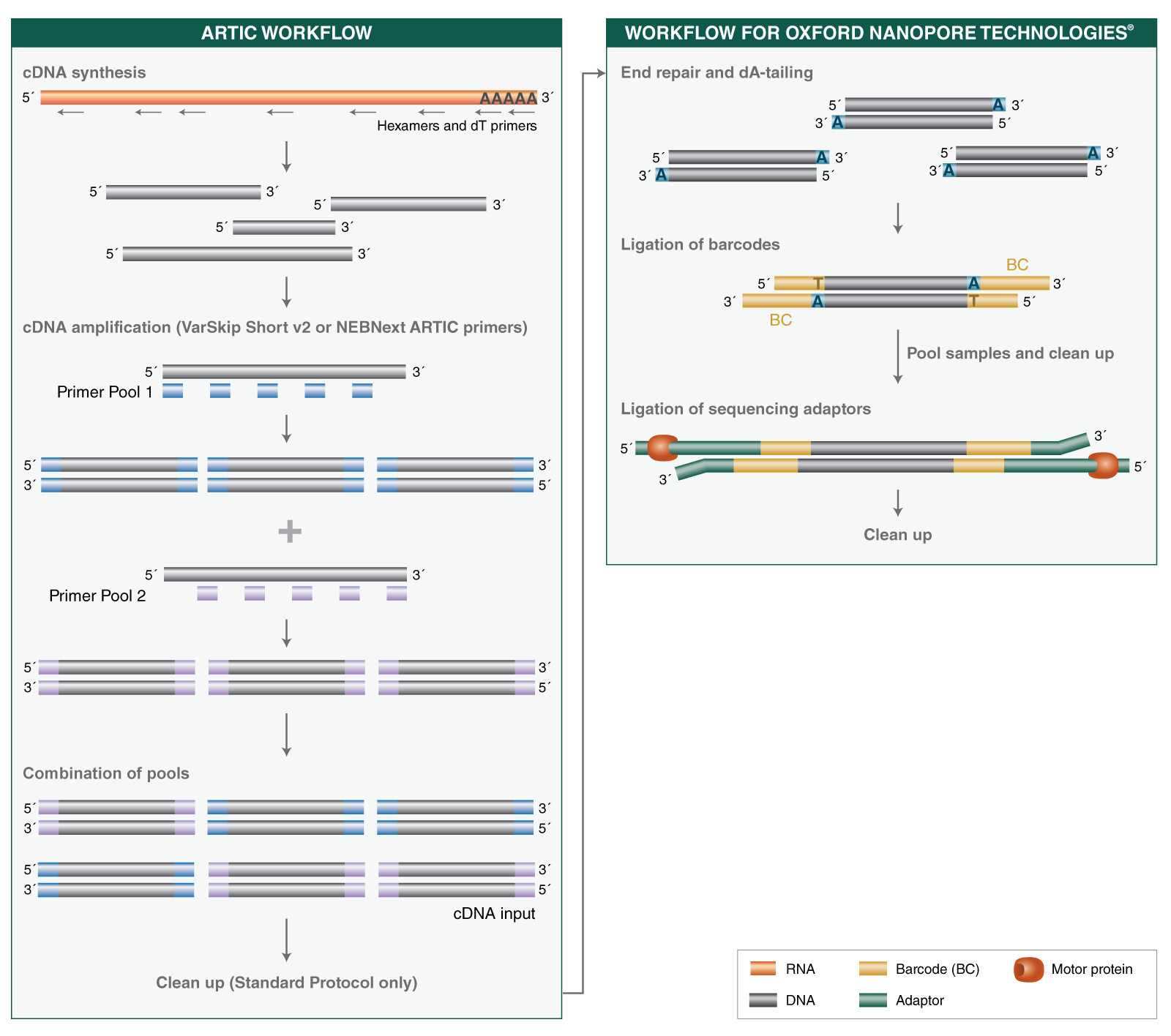
We use Artic v 5.3.2 primers.
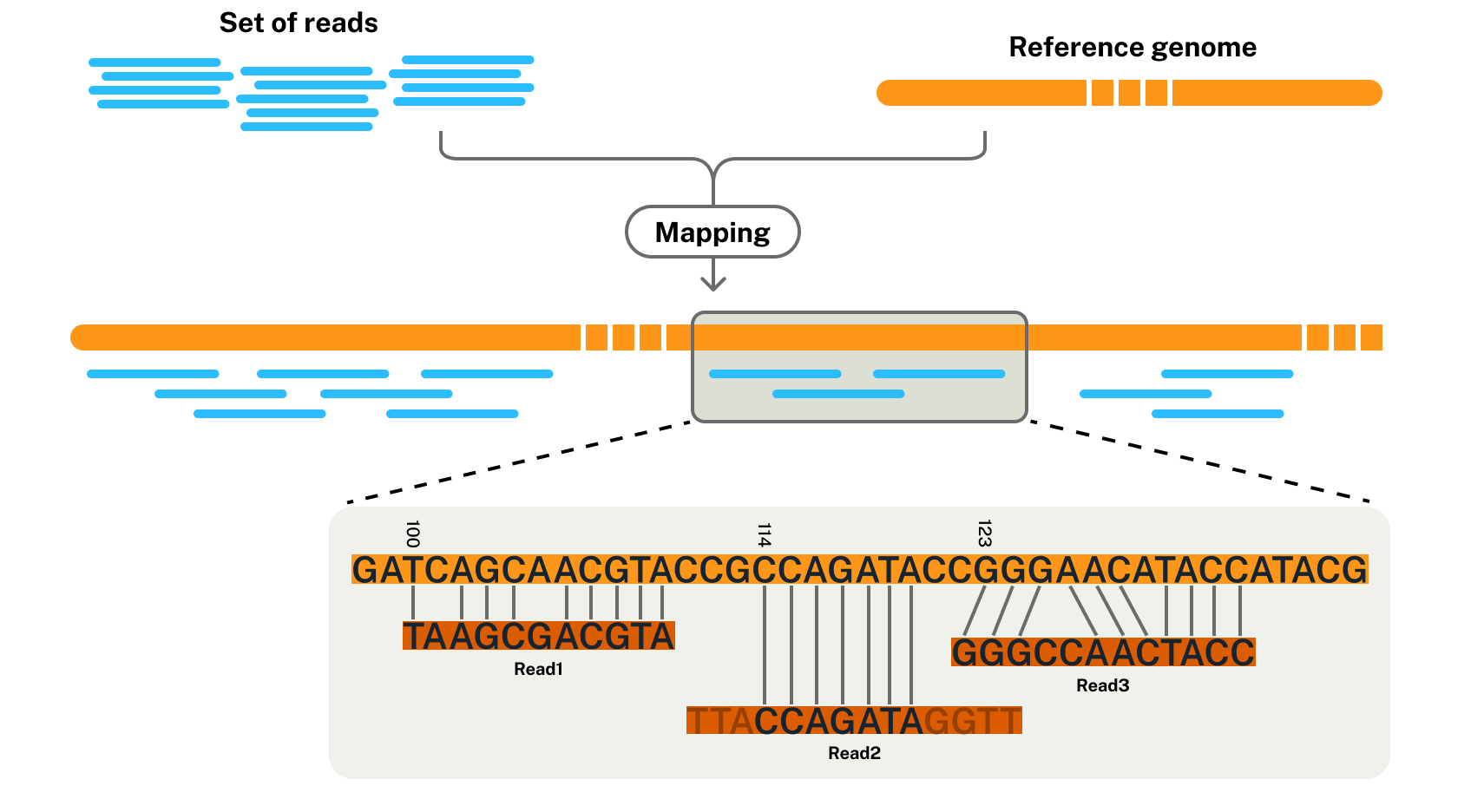
Mapping Assembly
Introduction
Sequence-based monitoring of global infectious disease crises, such as the COVID-19 pandemic, requires capacity to generate and analyse large volumes of sequencing data in near real time. These data have proven essential for surveilling the emergence and spread of new viral variants, and for understanding the evolutionary dynamics of the virus.
For efficient genome surveillance, we want to:
- use the mutations of each sample to construct its consensus genome
- use the consensus genomes to assign the samples to SARS-CoV-2 lineages, as defined by the major lineage classification systems (Nextstrain clades and PANGO).
- decrease hands-on time and data manipulation errors by combining analysis steps into workflows
In this tutorial, we use a set of workflows developed by the Galaxy Covid-19 project, together with a handful of additional tools:
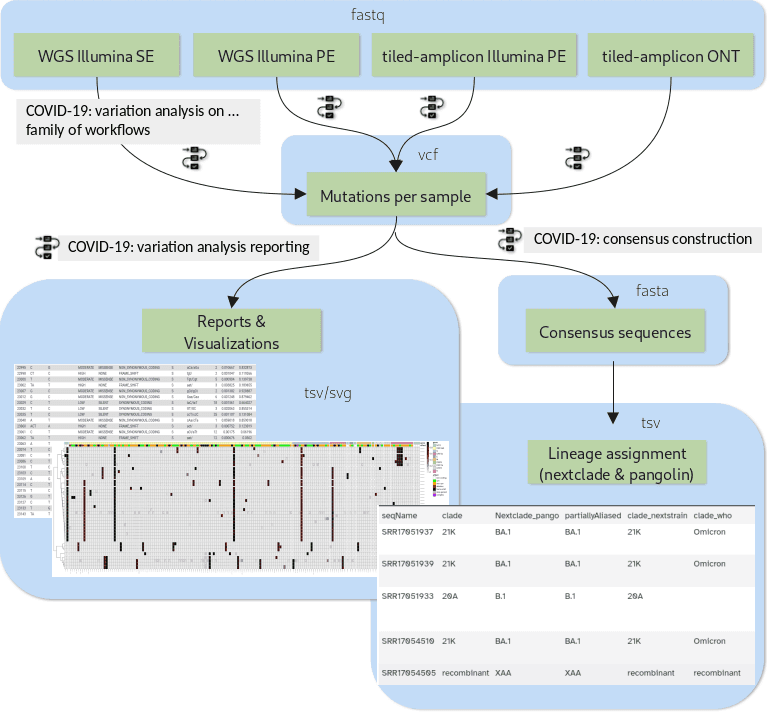
- The variation analysis workflow discovers the mutations of each sample of the batch. Different versions of this workflow exist for different types of data; we use the one for tiled-amplicon ONT data.
- The consensus construction workflow reconstructs the full viral genome of each sample by modifying the SARS-CoV-2 reference genome with the mutations of the sample.
- Pangolin and Nextclade assign the consensus genomes to lineages.
A few highlights of these workflows:
- The consensus workflow expresses uncertainty about any base position of the consensus sequence by masking it with an N, according to user-defined thresholds.
- All the workflows are openly developed and available as defined releases through public workflow registries.
Tiled-amplicon sequencing with ARTIC primers
The SARS-CoV-2 genome is ~30 kb long. In clinical samples, viral RNA is often present in low amounts and mixed with a lot of human RNA. To sequence it efficiently, the viral genome is first amplified by multiplex PCR with a set of primers producing short, overlapping amplicons that together tile the whole genome.
The most widely used primer sets were designed by the ARTIC network. In this tutorial, we use ARTIC v5.3.2: the genome is covered by ~100 amplicons of ~400 bp, split into two pools so that overlapping amplicons are not amplified in the same reaction. The primer schemes are regularly updated, because mutations of new variants can prevent some primers from binding: ARTIC v5 was released in 2022 to restore the amplification of regions affected by the mutations of the Omicron variants.
This approach has consequences for the analysis:
- The primer sequences must be removed from the reads: they come from the synthetic primers, not from the virus, and would hide the mutations located in primer binding sites. To do so, the workflow needs to know the positions of the primers on the genome (a BED file).
- Reads that look like duplicates are expected, because all reads of an amplicon start and end at the same positions. Unlike for whole-genome sequencing data, they are not removed.
- With ONT sequencing, each read usually covers a whole amplicon. Reads much shorter or longer than an amplicon (e.g. chimeric reads formed by two ligated amplicons) can be removed by filtering on read length.
Analysis of ONT data
The workflow for ONT tiled-amplicon data runs:
- fastp filters reads by length
- minimap2 aligns the reads to the reference
- samtools view drops unmapped and secondary alignments.
- ivar trim removes primer sequences using the ARTIC BED file.
- bamleftalign .
- Clair3 (Zheng et al. 2022) calls the variants and gives a VCF.
- Samtools stats, Qualimap and MultiQC produce QC reports.
Clair3 calls variants with a neural network trained on reads from a specific ONT chemistry (flow cell and kit, e.g. R10.4.1 E8.2) and basecaller model (e.g. Dorado v5.0.0 SUP). To run it on your own data, you need to know both, and choose the Clair3 model that matches them (e.g. r1041_e82_400bps_sup_v500). This information is usually in the run report of the sequencer, or in the header of the basecalled files.
Only a few models are available by default in Galaxy. If the model matching your data is not there, you may need to download it from the Clair3 pre-trained models (HKU or ONT Rerio models) and run Clair3 directly on your laptop.
Prepare Galaxy and data
Prepare a new Galaxy history
- Create a new history for this analysis
- Rename it, e.g.
SARS-CoV-2 ONT
Get sequencing data
We will get the sequencing data from a COVID-19 household cohort study in Chiang Mai, Thailand. If we look at the data sharing in the paper, we can see that the data is available under the ENA Project PRJEB104853.
The workflow expects a list collection with one FASTQ file per sample (ONT reads are single reads, not pairs). You need at least two samples, sequenced with ONT after amplification with the ARTIC v5.3.2 primers.
Create a new file with Upload → Paste/Fetch data, containing the SRA accessions of the samples, one per line:
ERR16054783
ERR16054815
ERR16054829
ERR16054845
ERR16054945
ERR16054982
ERR16055005
ERR16055067
ERR16055110
Set the datatype to
txtand name itSRA accessions.Open Faster Download and Extract Reads in FASTQ format from NCBI SRA with:
- “select input type”:
List of SRA accession, one per line - “sra accession list”:
SRA accessions
- “select input type”:
Click Run Tool
Rename the
Single-end data (fasterq-dump)collection toONT reads
Import the reference sequence and auxiliary datasets
Besides the reads, we need The reference sequence to call the mutations:
- the SARS-CoV-2 reference sequence, to map the reads and compare our samples against. We use the original Wuhan-Hu-1 genome, known as MN908947.3 in the INSDC databases and as NC_045512.2 in NCBI RefSeq
Upload the reference sequence with Upload → Paste/Fetch data, using this link, and set the datatype to
fasta:https://raw.githubusercontent.com/pha4ge/primer-schemes/main/schemes/artic-sars-cov-2/400/v5.3.2/primer.bed https://raw.githubusercontent.com/pha4ge/primer-schemes/main/schemes/artic-sars-cov-2/400/v5.3.2/reference.fastaClick on “Start”.
What is a BED file?
The Browser Extensible Data (BED) format is a simple text format to describe regions of a genome: genes, exons, peaks, or, in our case, primer binding sites. It is a tab-separated file with one line per region and no header. Only the first 3 columns are mandatory; the following ones are optional, but must appear in a fixed order.
Here are the first lines of the ARTIC v5.3.2 primer BED file:
MN908947.3  47  78  SARS-CoV-2_1_LEFT_1 1   +   CTCTTGTAGATCTGTTCTCTAAACGAACTTT
MN908947.3  419 447 SARS-CoV-2_1_RIGHT_1    1   -   AAAACGCCTTTTTCAACTTCTACTAAGC
MN908947.3  344 366 SARS-CoV-2_2_LEFT_0 2   +   TCGTACGTGGCTTTGGAGACTC
MN908947.3 707 732 SARS-CoV-2_2_RIGHT_0 2 - TCTTCATAAGGATCAGTGCCAAGCT| Column | BED field | In the ARTIC primer BED |
|---|---|---|
| 1 | chrom: name of the reference sequence |
MN908947.3, the INSDC name of the Wuhan-Hu-1 genome (same sequence as NC_045512.2) |
| 2 | chromStart: start position of the region |
Start of the primer binding site |
| 3 | chromEnd: end position of the region |
End of the primer binding site |
| 4 | name: name of the region |
SARS-CoV-2_<amplicon>_<LEFT/RIGHT>_<variant>: the amplicon number, whether it is the forward (LEFT) or reverse (RIGHT) primer, and an identifier for alternative versions of the same primer |
| 5 | score |
Used here to store the pool (1 or 2) in which the primer is used |
| 6 | strand |
+ for LEFT primers, - for RIGHT primers |
| 7 | Extra column | The primer sequence |
Two lines with the same amplicon number (e.g. SARS-CoV-2_1_LEFT_1 and SARS-CoV-2_1_RIGHT_1) delimit one amplicon. The file contains 193 primers for 96 amplicons: some amplicons have alternative primers, added to keep amplifying variants with mutations in the original binding site. You can also see that amplicons 1 and 2 overlap (amplicon 2 starts at position 344, before amplicon 1 ends at position 447), which is why they are amplified in different pools.
Unlike VCF files (see below), BED coordinates are 0-based and half-open: the first base of the genome is position 0, and the chromEnd base is not included in the region. The first primer, 47 78, therefore covers positions 48 to 78 of the genome in the usual 1-based numbering, i.e. 31 nucleotides, the length of its sequence. Keep this in mind when you compare positions between a BED file and a VCF file.
ivar trim uses this file to know where the primers are on the genome, and removes the primer sequences from the reads that overlap these positions.
Analysis
Import the workflows
All the originals workflows of the Galaxy Covid-19 project are published by the IWC (Intergalactic Workflow Commission) on Dockstore and WorkflowHub, and can be imported directly into Galaxy. I have updated them for this training.
- click on the workflow link. It should open the workflow preview:
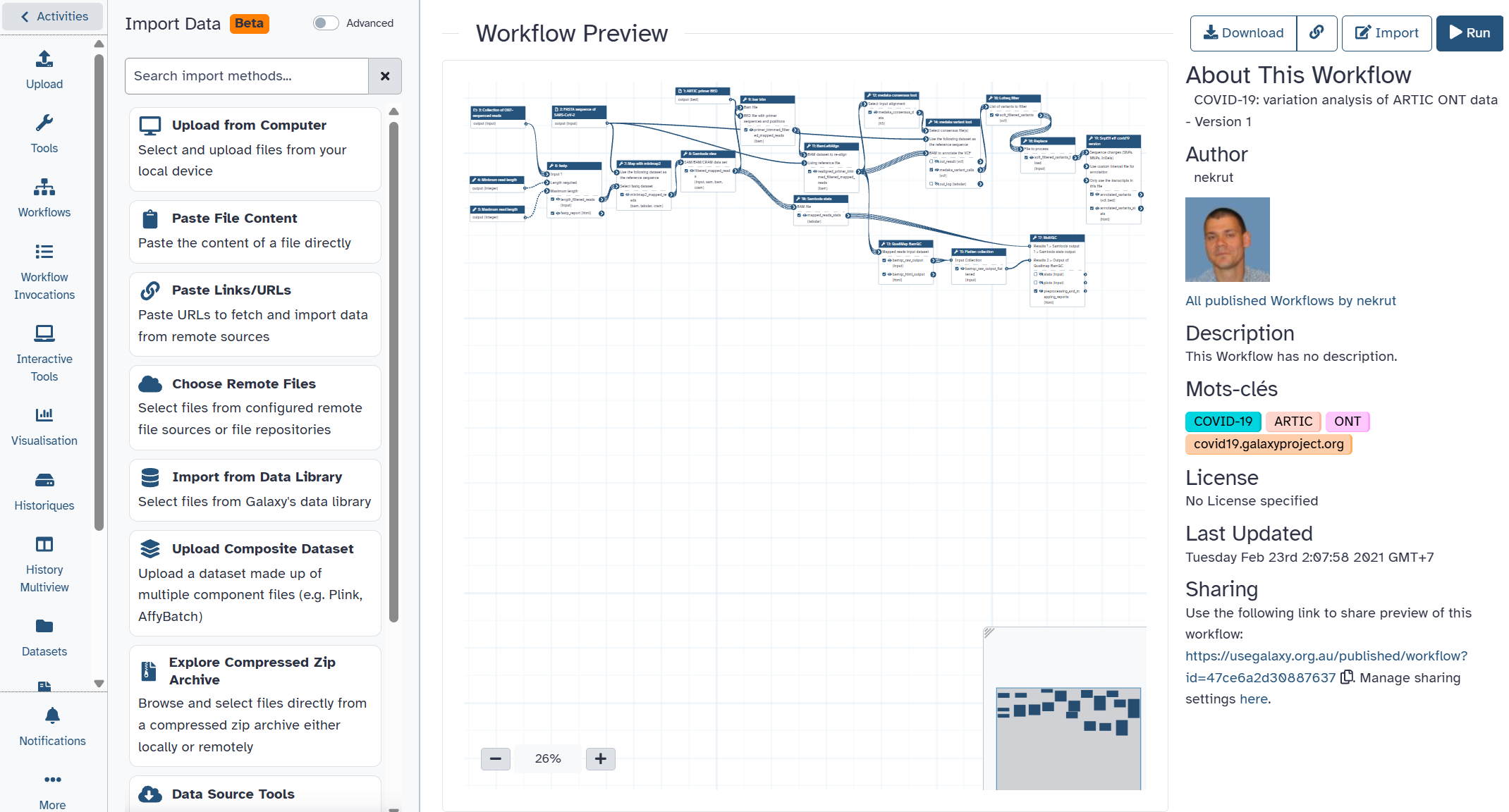
- Click on Import Worflow.
From sequencing data to mutations per sample
- Open the COVID-19: variation analysis of ARTIC ONT data workflow and set:
- “ONT-sequenced reads”:
ONT reads - “NC_045512.2 FASTA sequence of SARS-CoV-2”:
SARS-CoV-2 reference - “Primer binding sites info in BED format”:
ARTIC v5.3.2 primers
- “ONT-sequenced reads”:
- Click Run Workflow
Outputs of the variation analysis workflow
Each output is a collection with one element per sample. In the order in which the tools run, the workflow produces:
| Step | Tool | Output | Format | What it is |
|---|---|---|---|---|
| Read filtering | fastp | Length-filtered reads | fastqsanger |
The reads that pass the minimum and maximum read length filters |
| fastp report | html |
Read statistics before and after filtering | ||
| Mapping | minimap2 | Mapped reads | bam |
The reads aligned to the reference genome |
| Samtools view | Filtered mapped reads | bam |
Mapped reads only: unmapped reads, secondary alignments and reads with a mapping quality of 0 are removed | |
| Samtools stats | Mapped reads stats | tabular |
Mapping statistics (number of mapped reads, error rate…) | |
| Primer removal | ivar trim | Primer-trimmed reads | bam |
The primer sequences are cut from the reads using the primer BED file |
| BamLeftAlign | Realigned reads | bam |
Insertions and deletions are shifted to their left-most position, so that the same indel is always reported at the same position. These are the fully processed reads used for variant calling | |
| Coverage QC | QualiMap BamQC | BamQC report | html |
Coverage of the genome by the reads, per sample |
| MultiQC | Preprocessing and mapping reports | html |
One report gathering the Samtools stats and QualiMap results of all samples | |
| Variant calling | Clair3 | Variant calls | vcf |
The mutations found in each sample, annotated with read depth information |
The most important outputs for the rest of the tutorial are:
- the Preprocessing and mapping reports (MultiQC), to check the quality of the samples (see below)
- the VCF file ( VCF), the mutations used to build the consensus sequences.
- the fully processed reads (BamLeftAlign BAM), used to calculate the coverage in the consensus workflow
What is a BAM file?
The **Sequence Alignment/Map** format (SAM) is the standard text format to store reads aligned to a reference genome: for each read, where it maps and how it differs from the reference. A **BAM** file is the compressed, binary version of a SAM file: it is much smaller and faster to read for the tools, but it cannot be read directly by a human. BAM files are usually **sorted** by position on the reference and **indexed** (`.bai` file), so that the tools can quickly retrieve the reads covering a given region. When a dataset of type BAM is created, Galaxy automatically builds the .bai index and stores it as hidden metadata attached to that dataset. Tools that need an index (ivar trim, bamleftalign, Qualimap, bedtools and so on) get it transparently. Like VCF, SAM has two parts:- The header: lines starting with
@that describe the file: the reference sequence(s) and their length (@SQ), how the file is sorted (@HD), and the programs that produced the file (@PG). - The body: one line per alignment, with 11 mandatory columns, optionally followed by extra
TAG:TYPE:VALUEfields:
| Column | Meaning | In our SARS-CoV-2 BAMs |
|---|---|---|
QNAME |
Name of the read | The read ID given by the ONT basecaller |
FLAG |
Properties of the alignment, encoded as a sum of bit values (see below) | e.g. 0 (forward strand) or 16 (reverse strand) |
RNAME |
Name of the reference sequence | Always NC_045512.2 |
POS |
Leftmost position of the alignment on the reference (1-based) | Between 1 and 29,903 |
MAPQ |
Mapping quality: confidence that the read is mapped at the right place, as a Phred score | Reads with a MAPQ of 0 are removed by Samtools view |
CIGAR |
Description of the alignment, as a series of lengths and operations (see below) | e.g. 31S350M2D18M |
RNEXT, PNEXT, TLEN |
Position of the mate read and length of the fragment, for paired-end data | Always *, 0 and 0: ONT reads are single reads |
SEQ |
Sequence of the read | The full ONT read (~400 bp, the size of an amplicon) |
QUAL |
Base qualities of the read | The Phred qualities from the FASTQ file |
The FLAG is the sum of the properties that apply to the alignment. The most common ones for ONT data are 4 (read unmapped), 16 (read on the reverse strand), 256 (secondary alignment: another possible position of the same read) and 2048 (supplementary alignment: part of a chimeric read mapped elsewhere). The Explain SAM Flags website decodes any value.
The CIGAR string describes how the read is aligned, base by base. The most common operations are M (alignment match: the base can be identical or different from the reference), I (insertion in the read), D (deletion from the read) and S (soft clipping: bases kept in SEQ but not aligned). For example, 31S350M2D18M means: 31 unaligned bases, then 350 aligned bases, a deletion of 2 bases, and 18 more aligned bases.
ivar trim does not delete the primer bases from the reads: it soft-clips them. The primer bases are still in SEQ, but they are added to the S operations of the CIGAR, and POS is shifted to the first aligned base after the primer. Variant callers ignore soft-clipped bases, so the primer sequences no longer influence the mutation calls.
- Convert one of the fully processed BAM files to SAM with Samtools view (“Output format”:
SAM, with the header) and open it with the eye icon. Which reference sequence is described in the header? - Do the
CIGARstrings of the reads start or end with soft-clipped bases (S)? Why?
- The
@SQline describes the single reference sequence,MN908947.3, with its length:LN:29903. - Yes: most reads start and end with soft-clipped bases. Some of them were already clipped by minimap2 (e.g. sequencing adapters that do not align), and ivar trim soft-clipped the primers.
What is a VCF file?
The Variant Call Format (VCF) is the standard text format to store genetic variants: the positions where a sample differs from the reference genome. It is a tab-separated file with two parts:
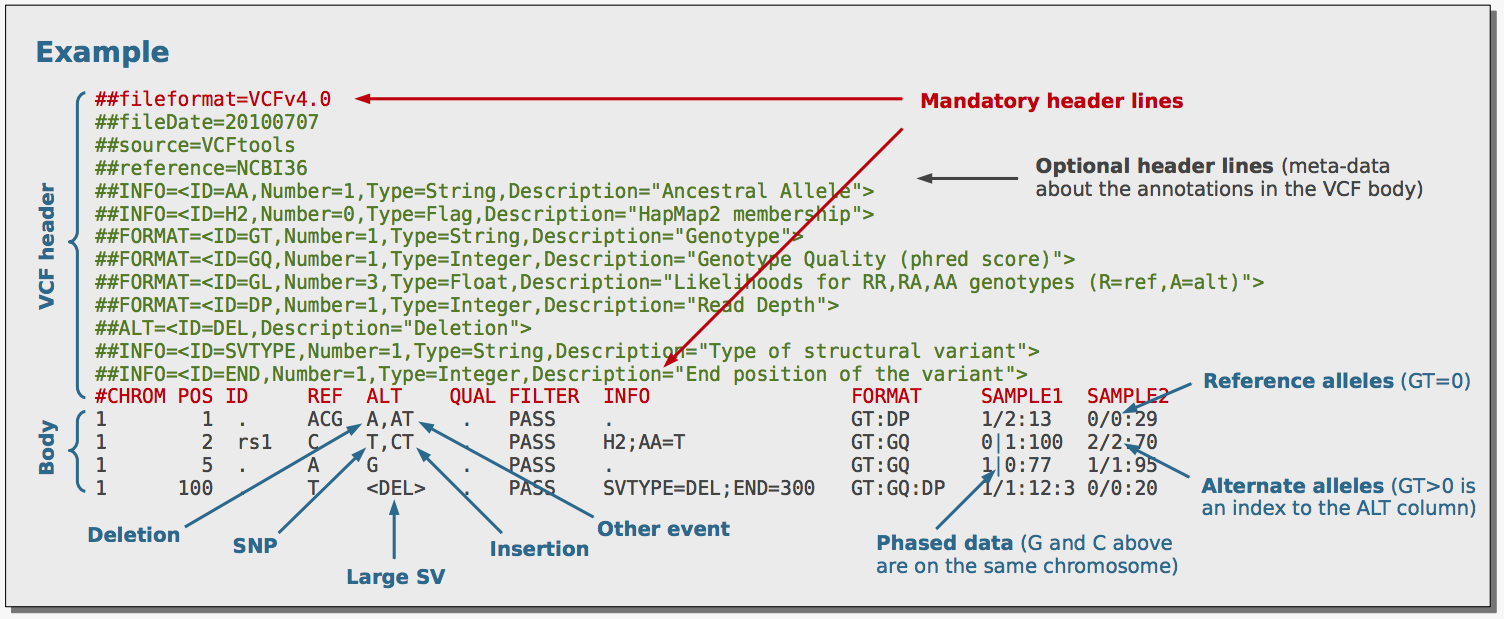
- The header: lines starting with
##that describe the file: the format version, the reference genome, the tools that created the file, and the meaning of each field used in theINFO,FILTERandFORMATcolumns. Read the header when you don’t understand a field: its definition is there. - The body: one line per variant, with 8 mandatory columns, optionally followed by a
FORMATcolumn and one column per sample:
| Column | Meaning | In our SARS-CoV-2 VCFs |
|---|---|---|
CHROM |
Name of the reference sequence | Always NC_045512.2: the viral genome is a single sequence |
POS |
Position of the variant on the reference (1-based) | Between 1 and 29,903, the length of the genome |
ID |
Identifier of the variant in a database (e.g. dbSNP) | Usually . (empty) |
REF |
Base(s) in the reference genome | e.g. A |
ALT |
Base(s) observed in the sample | e.g. G |
QUAL |
Confidence that the variant is real, as a Phred score | Higher is better |
FILTER |
PASS if the variant passed all filters, otherwise the name of the failed filter |
PASS, or LowQual for low-quality calls flagged by Clair3 |
INFO |
Additional information, as KEY=value pairs separated by ; |
P or F: whether the variant was called by Clair3’s pileup or full-alignment model |
FORMAT + sample |
Names of the per-sample fields, then their values for the sample | GT:GQ:DP:AD:AF: genotype, genotype quality, read depth, read counts per allele and allele frequency |
The type of variant can be read from the REF and ALT columns:
- SNP (single nucleotide polymorphism): one base replaced by another, e.g.
REF=A,ALT=G - Deletion:
REFis longer thanALT, e.g.REF=ATAC,ALT=A - Insertion:
ALTis longer thanREF, e.g.REF=A,ALT=ATT
VCF was designed for diploid organisms such as humans, where a sample can carry 0, 1 or 2 copies of a variant (its genotype, GT). A SARS-CoV-2 sample is a population of viral genomes: what matters is the allele frequency (the fraction of reads carrying the mutation), not the genotype. The consensus construction workflow uses it to decide which mutations to include in the consensus sequence.
- Open the VCF of one sample with the eye icon. How many mutations were found in this sample?
- Do all the mutations have
PASSin theFILTERcolumn?
- Count the lines of the body (the lines that don’t start with
#). Expanding the dataset in the history shows the number of lines, but it includes the header lines. - Not necessarily: Clair3 flags low-quality calls with
LowQualin theFILTERcolumn, but keeps them in the file. Only filter-passing mutations are used to build the consensus sequence.
The optional parameters “Minimum read length” and “Maximum read length” should match the amplicon sizes of the primer scheme. The workflow defaults are appropriate for the ARTIC primers. For another primer scheme, the ARTIC network’s recommendations (section “Read filtering”) are a good starting point: set the minimum to the size of the smallest amplicon, and the maximum to the size of the largest amplicon plus 200 nucleotides, to exclude obviously chimeric reads.
- Are there samples with a much lower number of reads or a lower coverage than the others?
- In the Cumulative genome coverage plot, which fraction of the genome is covered by at least 20 reads in each sample?
- Look at the General Statistics section. Samples with a critically low coverage will give unreliable mutation calls, and probably incomplete consensus sequences.
- A curve that drops early means that large parts of the genome are poorly covered, for example because some amplicons failed.
From mutations per sample to consensus sequences
Here is the link to the last workflow, the COVID-19 CONSTRUCTION WORKFLOW.
The last workflow generates consensus sequences according to transparent criteria:
- Each consensus sequence contains all the filter-passing mutations of its sample that reach a user-defined consensus allele frequency threshold.
- Positions of filter-passing mutations with an allele frequency between the two thresholds are masked with N.
- Positions with a coverage below a depth threshold are masked with N too, unless they are sites of consensus mutations.
- Open the COVID-19: consensus construction workflow and set:
- “Variant calls”: the Clair3
Variant callscollection produced by the first workflow - “aligned reads data for depth calculation”:
Fully processed reads for variant calling(the BAM files produced by the first workflow) - “Reference genome”:
SARS-CoV-2 reference
- “Variant calls”: the Clair3
- Leave “min-AF for consensus variant”, “min-AF for failed variants” and “Depth-threshold for masking” at their default values
- Click Run Workflow
The main outputs of the workflow are:
- a collection of consensus sequences, useful to look at the consensus sequence of one sample
Open your VCF file in a Genome Viewer
We can use Jbrowse2.
From consensus sequences to lineage assignments
Open Nextclade, you need your consensus sequences. Download them from Galaxy, using the “Download” button.
Conclusion
In this tutorial, we used a set of Galaxy workflows to analyse a batch of SARS-CoV-2 samples sequenced with ONT after amplification with the ARTIC v5.3.2 primers:
- The variation analysis workflow filtered the reads, mapped them to the reference genome, removed the primers and called the mutations of each sample
- The consensus construction workflow reconstructed the genome of each sample, masking the uncertain positions
- Pangolin and Nextclade assigned the samples to lineages
The workflows can analyse many samples with little hands-on time, while still allowing detailed dives into individual samples. To scale up further, workflow runs can be automated through the Galaxy API, as the Galaxy Covid-19 project did to analyse hundreds of thousands of public SARS-CoV-2 sequencing datasets (Infectious Diseases Toolkit).
- For tiled-amplicon data, the workflow needs the primer scheme (BED file) to remove the primer sequences, which would otherwise hide mutations in primer binding sites.
- The ONT workflow uses minimap2 for mapping and Clair3 for variant calling, with a model matching the ONT chemistry and basecaller; reads are filtered on length to match the amplicon sizes.
- Always check the coverage of the samples: low coverage leads to missed mutations, N-masked consensus sequences and unreliable lineage assignments.
- Mutations at intermediate allele frequencies can reveal contaminations or co-infections, which a single consensus sequence cannot represent.
- Pangolin and Nextclade use different algorithms and nomenclatures; comparing them, together with their quality columns, helps to spot unreliable assignments.