Bacterial Genome Assembly Tutorial
Bacterial Genome Assembly
Questions
- Why do bacterial genomes need to be assembled?
- What is the difference between reads, contigs, and scaffolds?
- How do assemblers reconstruct a bacterial genome?
- How do we assess the quality of an assembly?
Objectives
- Understand what a genome assembly is.
- Know the main assembly algorithms (Greedy, OLC, De Bruijn Graphs).
- Perform a bacterial genome assembly using SPAdes.
- Evaluate the assembly using QUAST.
What is an assembly ?
Modern sequencing technologies generate millions of short DNA fragments (reads), but not complete chromosomes.
For bacterial genomics, our goal is to reconstruct the full genome of a bacterial isolate from these fragments.
The process of stitching reads together into longer sequences is called de novo assembly.
Introduction
When the quality of the reads is determined and the data is filtered (like we did with fastp) and/or trimmed (like is more often done with short read data) an assembly can be made.
Assembling a genome is conceptually similar to solving a jigsaw puzzle:
- The full genome is the picture we want to reconstruct.
- Reads are the small pieces of the puzzle.
- Overlaps and repeated patterns determine how the pieces fit together.
Unlike real puzzles, genome assembly is complicated by:
- Sequencing errors
- Repeated regions that appear identical
- Uneven sequencing depth
- Contaminations in the sample
Despite these challenges, bacterial genomes (~1–7 Mb) are typically easier to assemble than metagenomes because they come from one organism and generally have uniform coverage.
The type of assembly
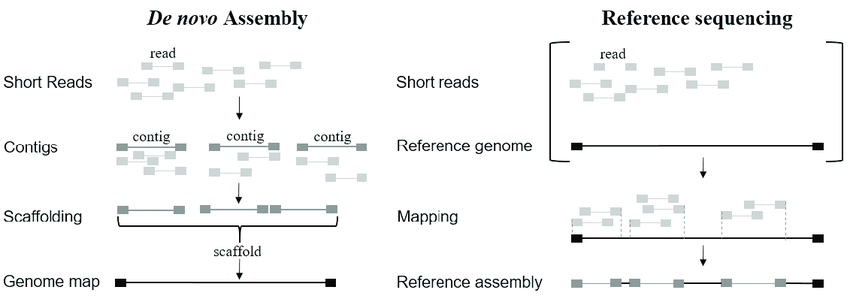
Reference-Based Assembly (Mapping)
Reference-based assembly aligns sequencing reads to an existing reference genome. This approach: - Requires a high-quality reference genome from the same or closely related species - Is faster and computationally lighter than de novo assembly - Works well for variant detection, SNP calling, and comparative genomics - Limitations: Cannot detect novel sequences, large structural variations, or genomic regions absent from the reference
De Novo Assembly
De novo assembly reconstructs the genome from scratch without using a reference. This approach: - Builds consensus sequences by finding overlaps between reads - Is essential when no reference genome exists or when studying novel organisms - Can detect structural variations, insertions, deletions, and novel genetic elements - Limitations: More computationally intensive, may produce fragmented assemblies (multiple contigs instead of complete chromosomes)
Read the referenced paper and answer the following questions:
- What kind off assembly has been chosen in the paper ?
- Discuss with your neighbor, about this choice.
The authors chose a de novo hybrid assembly, combining Illumina short reads and Nanopore long reads. While reference-based assembly is faster, de novo assembly was essential for this study because the authors wanted to:
- Capture the complete and unique genomic content of each strain, including its plasmids, which vary a lot between E. coli strains and are absent from reference genomes
- Locate the antibiotic resistance genes (ESBL and carbapenemase genes) on the chromosome or on plasmids, to understand how they spread between strains
- Compare whole plasmid sequences between strains, which requires complete, circular plasmids
- Understand genomic diversity without bias from an existing reference
The hybrid approach was needed to recover complete plasmids: short reads alone give fragmented assemblies in which plasmid and chromosome contigs cannot be told apart.
How Do DE NEVO Assemblers Work?
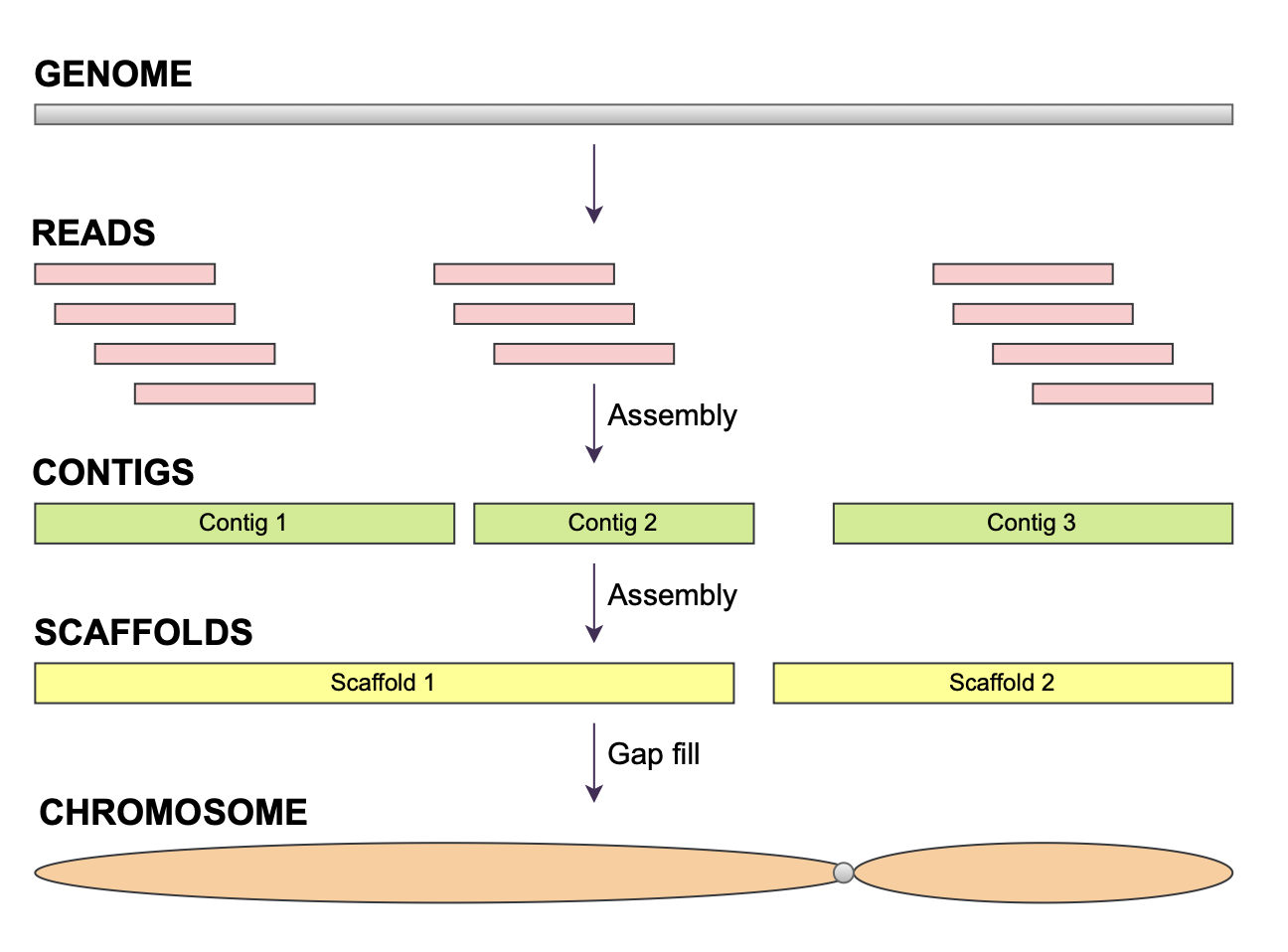
Reads → Contigs → Scaffolds
During de novo assembly, the algorithm steps are typically:
- Reads (raw sequencing fragments)
- Contigs: overlapping reads merged into longer continuous sequences
- Scaffolds: contigs ordered and oriented using paired-end information (Mainly useuful for visualization)
The figure below shows the hierarchy:
There are several strategies to assemble genomes. Most modern short-read assemblers use De Bruijn Graphs.
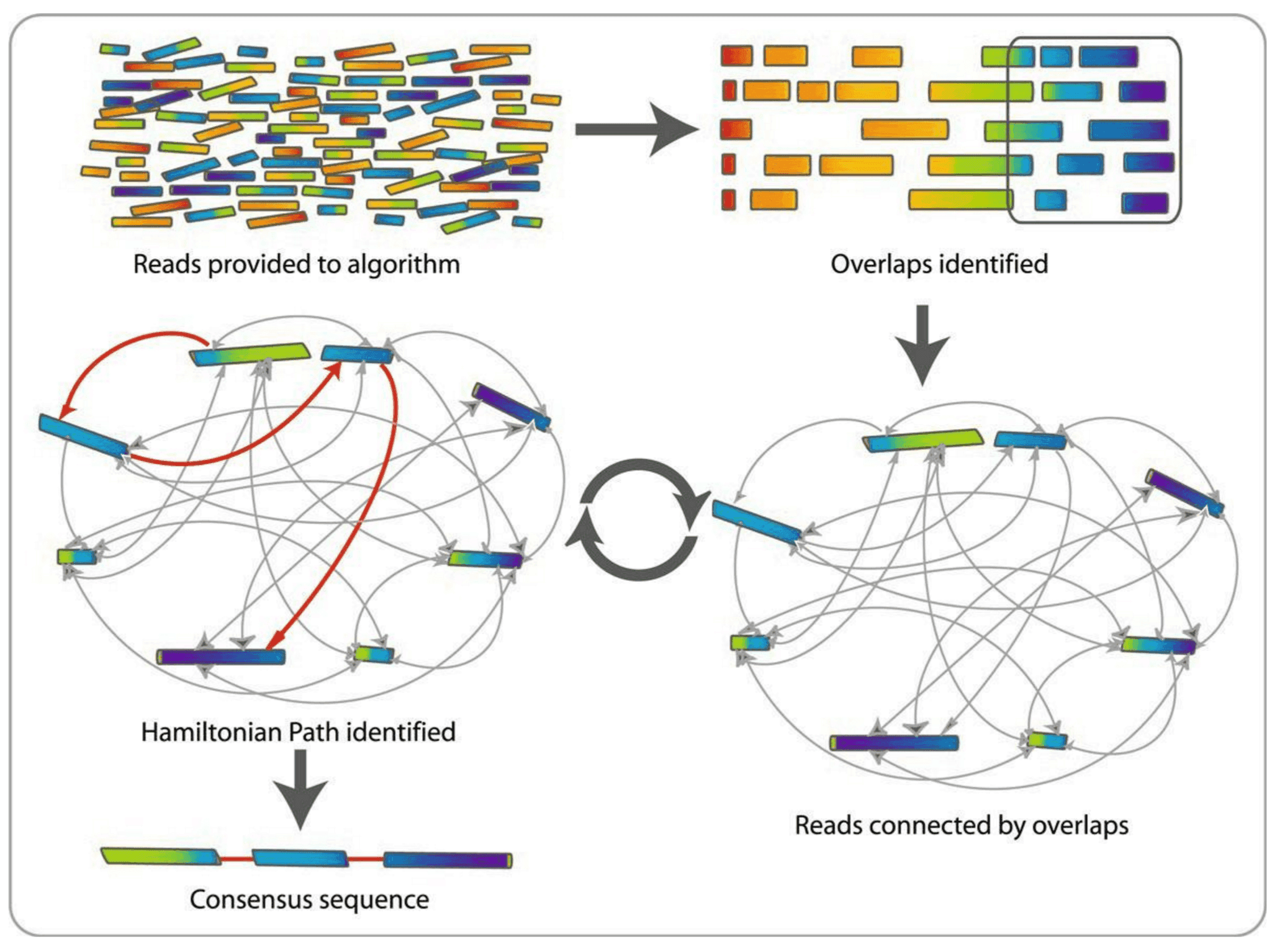
Reads are broken into k-mers (short subsequences of length k).
A graph is built from overlapping k-mers, and contigs are extracted as paths through the graph.
This method is extremely efficient for large numbers of short reads. For further explanations, see this assembly presentation.
Short read assembly
SPAdes: A Popular Bacterial Genome Assembler
SPAdes (St. Petersburg genome assembler) is one of the most recommended tools for bacterial genomes.
Why SPAdes?
- Designed specifically for single bacterial genomes
- Handles uneven coverage (useful for plasmids or mixed samples)
- Uses multi-k De Bruijn Graphs for improved assembly
- Widely used, well tested, fast
SPAdes takes FASTQ files as input and outputs:
- contigs.fasta
- scaffolds.fasta
- assembly graph files
Running SPAdes on Galaxy
We will use the trimmed short reads of run ERR13363306 (collection Trimmed Short Reads), from the E.Coli Paper.
What parameters do I need to choose for SPAdes ? the most important is k-mers.
Always check the read length distribution and median/mean length of the trimmed reads (in the After filtering section of the fastp report) before finalizing k choices. Choosing an appropriate k-mer range for SPAdes assembly requires balancing sensitivity and contiguity. Smaller k values (e.g., 21–33–55) are more sensitive and help assemble low-coverage regions and short or repetitive sequences, whereas larger k values (e.g., 77–99–127) improve contiguity and repeat resolution but require longer, high-quality reads. Therefore, the k-mer range should always be chosen according to the read-length distribution and expected coverage after trimming
Create a new history
- Go to the History panel (right side).
- Click ✏️ → Create new history.
- Click Edit next to the history name.
- Rename it to Short Read Genome Assembly.
- Click Save.
Import the trimmed reads
Use the History Multiview panel.
- Open the History Multiview (left panel).
- Drag your trimmed paired-end reads (Trimmed Short Reads) from the previous history (e.g., “Quality Control and Trimming”).
- Drop them into the Short Read Genome Assembly history.
Assembly with SPAdes
Launch the SPAdes tool
- In the Galaxy tools panel, search for SPAdes.
- Click SPAdes genome assembler.
Tool parameters
1. Input Data
Choose:
- Paired-end: list of dataset pairs
- Ensure the correct trimmed R1/R2 files are selected.
2. Options to select
in Operation mode, select : Assembly and error correction. SPAdes performs BayesHammer/Hammer error correction on the raw reads before doing the assembly. (fixes substitutions & small indels, removes low-quality kmers), which improve assembly quality but takes longer.
in Pipeline Options: tick Isolate (
--isolate). This mode is recommended for the DNA of a single bacterial culture sequenced at high coverage, which is our case (~100x): it improves the assembly and reduces the running time.Select additional outputs:
- Contigs
- Scaffolds
- Assembly graph with scaffolds
- Log
- Contigs
Select k-mer detection option: Select Auto, or use “21, 33, 55, 77”, commonly used for ILLUMINA for max length 150pb.
Click Run Tool.
Assembly usually takes a few minutes depending on coverage and read depth.
Galaxy Outputs
SPAdes generates several output files with different assembly representations. Rename them as indicated, so that you can find them easily in the next tutorials.
| Galaxy output | Rename it | Content |
|---|---|---|
| SPAdes on data X and data X: Contigs | SPAdes contigs Short Reads | Basic contigs without scaffolding. No gaps (N): the most conservative assembly. |
| SPAdes on data X and data X: Scaffolds | SPAdes scaffolds Short Reads | Contigs linked together using paired-end information. Gaps are represented as runs of N where SPAdes inferred a connection: longer sequences, but with uncertainties. |
| SPAdes on data X and data X: Assembly graph with scaffolds | SPAdes assembly graph Short Reads | The de Bruijn graph, with the scaffolding information (how the contigs connect). Used for the visualisation with Bandage. |
| SPAdes on data X and data X: Log | SPAdes log Short Reads | The messages written by SPAdes during the run: the k-mer sizes used, the steps, and the errors if the run failed. |